Future of Food
Why We Initiated the Project
The Lawrence Hall of Science initiated Future of Food to confront one of humanity’s most urgent global challenges: building food systems that sustain both people and the planet. Traditional science museum models often translate complex global topics from the top down, focusing strictly on academic expertise. We wanted to upend this paradigm by centering the intersection of climate change, food insecurity, public health, and environmental justice through a new guiding question: What matters most to our communities? Our goal was to create an inclusive civic platform where local lived experiences, cultural traditions, and scientific innovation unite to inspire collective action and expand representation in STEM.
How It Was Carried Out
The project was executed through a deeply collaborative, community-engaged design process anchored by the museum’s Innovation Integration Framework. Over a multi-year development period, we partnered with approximately 230 individual collaborators representing 150 diverse organizations. Co-creators included East Bay residents, Indigenous Ohlone knowledge holders, urban farmers, youth leaders, food justice advocates, and university researchers. Through co-design workshops and iterative prototyping, community-generated priorities directly dictated the exhibition’s core themes. To ensure deep structural equity, the entire exhibition was developed natively in both English and Spanish, alongside prominent integration of the Chochenyo language developed in direct partnership with the local Ohlone community.
What Was Produced
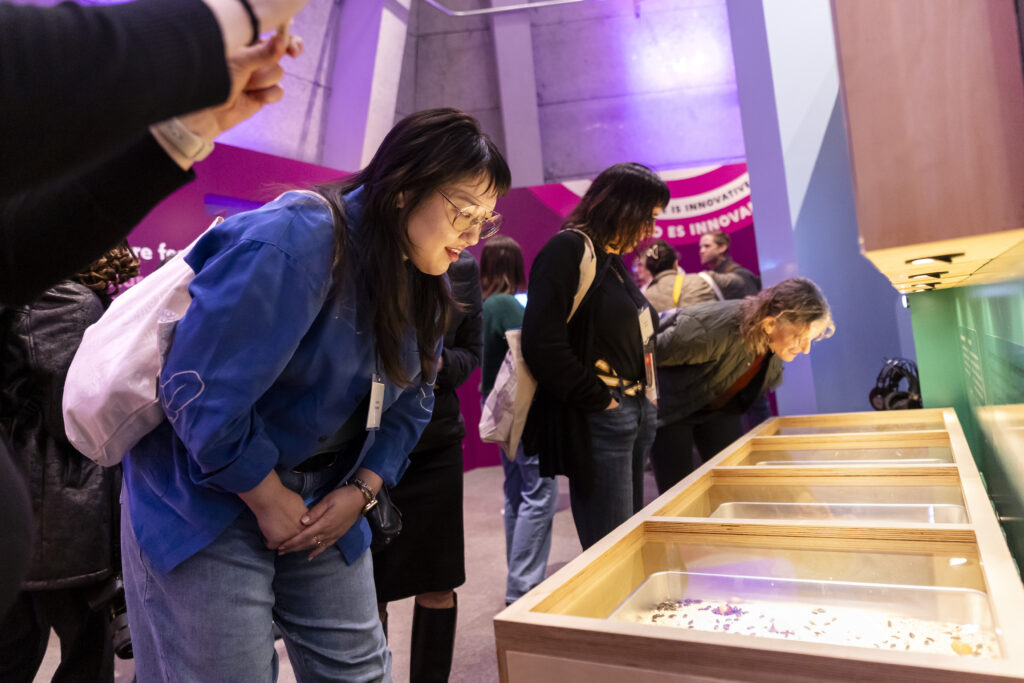
The result is a dynamic, 5,000-square-foot exhibition that positions cutting-edge science and community expertise as equal partners in bringing about the future of food. The gallery is divided into immersive spaces showcasing how the future of food will be Bioengineered, Aquatic, Innovative, Climate-Friendly, Robotic, Underground, and Nourishing. Visitors engage with highly tactile, intergenerational installations, such as an alternative protein bacon kelp forest, inflatable corn toss, an immersive soil tunnel, a play garden and kitchen, and a hands-on agricultural robotics activity. To center human impact, each experience spotlights a local Food Hero, utilizing evocative photography and cinematic storytelling to celebrate the diverse leaders and changemakers who define the East Bay’s cultural and innovation landscape.
The Impact of the Project
Since its launch, Future of Food has welcomed over 167,887 visitors and generated 724 million media impressions. Rigorous external evaluation demonstrated profound audience resonance: the exhibition achieved an outstanding Net Promoter Score of 71, with over 90% of visitors stating that the space felt deeply relevant to their lives, mirrored their communityvalues, and motivated them to act. The exhibition also captured remarkable physical engagement, with roughly two-thirds of visitors staying between 15–30 minutes, and another 24% staying up to 45 minutes. Most importantly, the project has permanently transformed institutional practice at The Lawrence, solidifying long-term structural commitments to bilingual interpretation, Indigenous collaboration, and community-authored design frameworks.