BioOCAnomia Amazônica
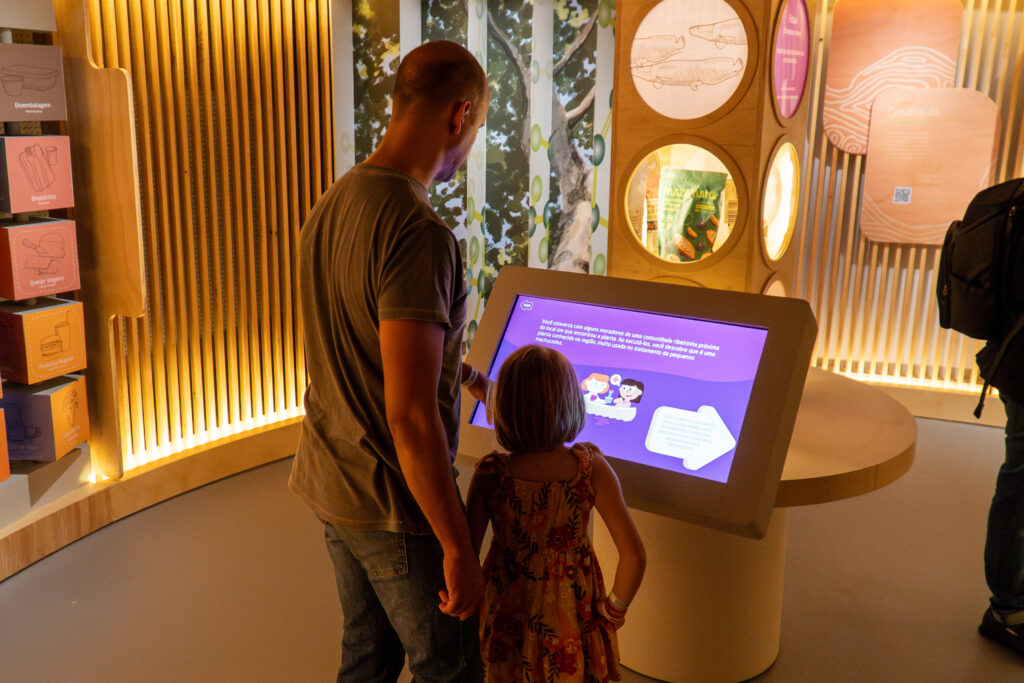
SESI Lab initiated BioOCAnomia Amazônica to address one of today’s most urgent questions: how to imagine development models that protect biodiversity, strengthen traditional communities and connect technological innovation with climate responsibility. Created for SESI Lab’s 2024 annual program on Biodiversity and the Bioeconomy, the project invited audiences to understand the Amazon not only as a territory of exceptional natural richness, but as a living system essential to global environmental balance, social justice and the future of production.
The project responded to the limitations of conventional narratives that portray the Amazon mainly through environmental loss or economic exploitation. Instead, it proposed a standing-forest economy rooted in Indigenous and traditional knowledge, scientific research and fair benefit-sharing. Its title combines bioeconomy with oca, the Indigenous dwelling, symbolizing a knowledge system generated from within the forest itself and grounded in collective well-being, responsibility and ecological resilience.
The exhibition was developed through a collaborative curatorial process involving Indigenous representatives, scientists, artists, educators, museum’s team and industry specialists. This shared approach shaped the content, interpretive strategies and visitor experience, transforming the museum into a civic forum where different forms of knowledge could meet on equal terms. Scientific data on deforestation, carbon sequestration, climate regulation and biodiversity was translated into sensory, interactive and accessible experiences, including installations, games, immersive audiovisual environments, workshops and mediated visits.
Organized into six interconnected thematic sections, BioOCAnomia Amazônica explored ancestral technologies, medicinal knowledge, sustainable production chains and new economic possibilities. The project extended beyond the galleries through the BioOCAnomia Festival, with transdisciplinary panels involving public authorities, researchers and traditional communities, and through Night Lab, which engaged urban audiences with workshops, science talks and concerts. Accessibility and inclusion were embedded through Brazilian Sign Language interpretation, audio narration, tactile maps, Braille materials, and low-stimulation visiting days for neurodivergent audiences.
SESI Lab produced a major exhibition, a digital exhibition, educational activities, public programs, debates, workshops, concerts, mediation strategies and editorial materials, including a brochure, a educative material and catalog. Together, these outputs created a broad platform for science communication, environmental education and public participation, making complex ideas about bioeconomy, climate change and socio-biodiversity accessible to diverse audiences.
Key project impacts: more than 57,000 visitors reached over five months; approximately 70% of participating students came from public schools; 96% of visitors deepened their understanding of threats to Amazonian diversity; recognition of the importance of protecting traditional communities increased from 65.1% to 84.8%; 95.3% agreed that Amazonian peoples and ecosystems offer knowledge for new ways of producing; and the exhibition achieved a Net Promoter Score of 60.9, with 70% of visitors classified as promoters.
Visitor evaluation showed that the exhibition stimulated interest and dialogue and offered a satisfying experience. Some tools, especially a quiz, proved effective in encouraging interaction among group members, while visual resources worked well when they presented something unexpected or activated personal memories. These findings confirm the value of participatory and visual strategies in science and technology museums.
By connecting ancestral wisdom, contemporary science and responsible innovation, BioOCAnomia Amazônicashowed how a science and technology museum can support transformative futures and encourage alternatives to extractive models.